Tony's Review of the Science of Dune
- Tony Travis

- Aug 31, 2025
- 2 min read
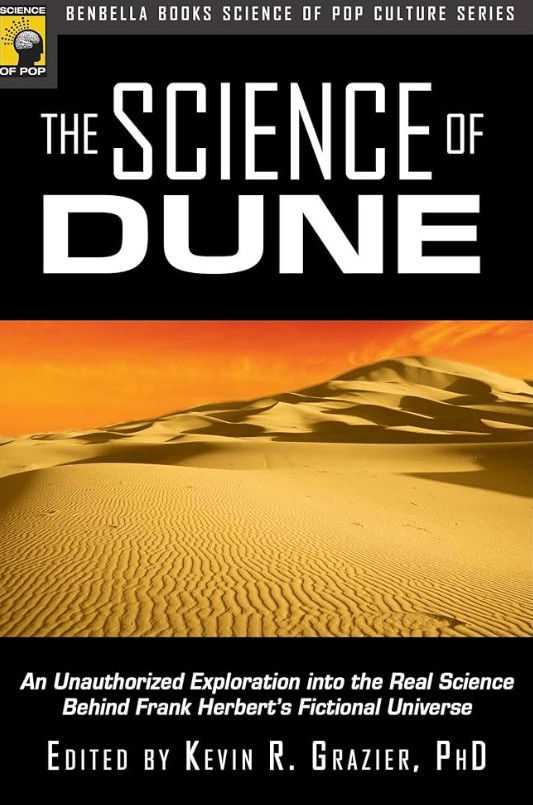

The Science of Dune takes the legendary world of Frank Herbert’s Dune and looks at it through the lens of modern science. This is not a retelling of the story, but rather a deep dive into whether the great ideas Herbert explored could exist, or at least be imagined, in the real universe. The book is made up of essays by scientists, scholars, and experts, all of them tackling different aspects of the saga.
The focus ranges from the ecology of Arrakis, to the biology of the sandworms, to the possibility of creating and controlling something as powerful as the spice melange. There are discussions on physics, genetics, and even human evolution, all tied back to the themes Herbert wove into his universe. What works so well is how these essays respect the source material while also treating it with critical analysis.
Herbert built his saga around complex, layered ideas—religion, politics, ecology—and this book shows just how much real-world science shaped his thinking. The ecological balance of Arrakis, for example, is not simply a fantasy but rooted in real environmental science. The sections on human potential, like the Bene Gesserit’s control of their bodies or the mentats replacing computers, push the discussion into how close—or how far—we are from such abilities.
This is a book that will appeal not only to science fiction fans but to anyone who enjoys seeing how imagination and science can spark off each other. It is also worth noting that it doesn’t try to “prove” Dune’s science is all real, but rather explores what could be possible and what remains purely speculative.
In the broader sense, The Science of Dune shows how influential Herbert’s creation has been. It is rare for a science fiction work to receive this level of scientific attention, and it highlights how deeply Dune has embedded itself into both popular culture and intellectual discussion.
For anyone who loves Dune and wants to take a step further into its ideas, this book is worth picking up. It deepens appreciation for Herbert’s masterpiece and shows just how forward-thinking he was when he created his desert world.


Comments